Executive Whitepaper: The Strategic Evolution of Tunable White (CCT) LED Strip Lighting
In modern architectural, commercial, and high-end residential lighting design, static color temperature is rapidly becoming obsolete. The global lighting market has reached a critical turning point where Dynamic Dynamic White (Tunable White) LED Strips and continuous linear sheet engines serve as foundational building blocks for Circadian Rhythm Lighting, Human-Centric Lighting (HCL), and adaptable commercial spaces. As a premier OEM/ODM manufacturer headquartered in Shenzhen, Shenzhen Covek Lighting Co., Ltd. (founded in 2011) operates at the forefront of this photobiological and technological revolution.
Tunable white technology allows precise control over Correlated Color Temperature (CCT)—typically bridging ultra-warm 2200K or 2700K up to crisp daylight 6500K—while independently controlling illuminance levels. Achieving flawless tunable white lighting requires far more than placing warm white and cool white diodes side-by-side on a Flexible Printed Circuit (FPC). It demands rigorous thermal engineering, advanced phosphor formulations, tight MacAdam Ellipse binning tolerance, multi-channel pulse-width modulation (PWM) driver synchronization, and optical diffuser matching to eliminate color-over-angle artifacts.
1. Corporate Strengths & Technical Superiority of Covek Lighting
Shenzhen Covek Lighting Co., Ltd. operates a TÜV Rheinland-verified 5,175 square meter manufacturing facility staffed by 133 specialized lighting engineers and production specialists. Rather than functioning purely as an assembly plant, Covek provides total vertical integration across the linear lighting manufacturing chain—from surface-mount technology (SMT) packaging and flip-chip COB encapsulation to silicone neon co-extrusion and rigorous photometric testing via integrating spheres and goniophotometers.
3-SDCM MacAdam Binning Consistency
Color variation across continuous runs destroys architectural aesthetics. Covek enforces strict 3-step MacAdam Ellipse binning for all CCT LED chips. Whether procuring 5 meters or 50,000 meters, lot-to-lot color uniformity is guaranteed without visible tint discrepancies.
High CRI Ra>95 & TM-30 Compliance
Standard LED strips sacrifice spectral quality for raw lumen output. Covek Tunable White products deliver Color Rendering Index (CRI) Ra > 95, R9 > 90 (vibrant deep red rendering), and optimized Fidelity (Rf > 92) and Gamut (Rg > 100) scores under IES TM-30 standards.
Robust Heavy-Copper FPC Substrates
Voltage drop leads to premature dimming and chromatic shift toward the far end of long strip runs. We utilize 3oz to 4oz rolled-annealed double-sided copper FPCs, dramatically lowering internal electrical resistance and operating junction temperatures.
Full OEM / ODM White-Label Customization Capabilities
To support global lighting brands, engineering contractors, and OEM distributors, Covek offers complete custom engineering services:
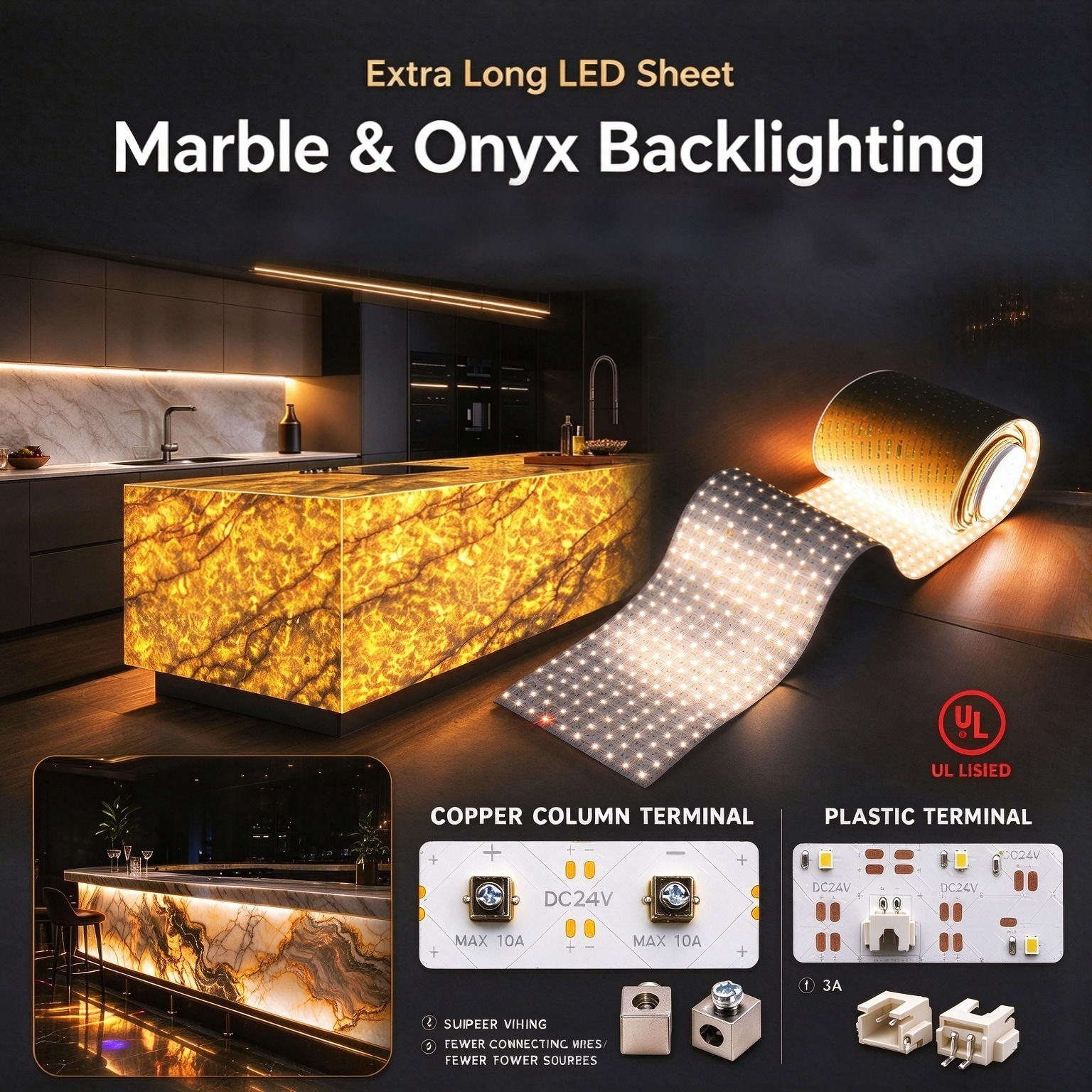
- Custom FPC Widths & Densities: From ultra-narrow 3mm FCOB strips for recessed cabinetry to 610mm wide cuttable matrix LED sheets for stone backlighting.
- Spectrally Customized Chipsets: Tailored CCT tuning ranges (e.g., 1800K Warm Dim to 4000K, or 2700K to 6500K circadian tuning) utilizing dual SMD2835, 2-in-1 CSP, or continuous FCOB phosphors.
- Protection Grades & Encapsulation: Precision IP20 indoor, IP54 nano-coated dust resistance, IP67 silicone extrusion for wet locations, and IP68 solid silicone filled for submersible fountains.
- Private Label & Packaging: Customized reel printing, branded packaging, custom barcode serialization, drop-test verified master cartons, and pre-wired IP67 quick connectors.
2. Photometric & Engineering Physics of Tunable White LED Systems
Achieving realistic dynamic white light requires precise navigation across the Planckian Locus (Black Body Locus) on the CIE 1931 chromaticity diagram. When mixing two distinct LED color temperatures—such as a 2700K warm diode and a 6500K cool diode—the resulting mixed color moves along a straight line connecting those two chromaticity coordinates on the CIE chart.
Because the Planckian Locus is inherently curved, simple 2-channel linear mixing can cause the mixed CCT to rise slightly above the black body curve at mid-range color temperatures (e.g., 4000K), introducing a slight green tint (positive Duv). To correct for Duv deviations and maintain pristine white light across all tuning steps, Covek employs advanced multi-channel mixing algorithms, optimized phosphor blends, and 3-channel (Warm White + Neutral White + Cool White or CCT + Red shift) configurations for critical museum and luxury retail projects.
Comparative Structural Architecture: SMD vs. FCOB vs. Matrix LED Sheet
B2B buyers must evaluate structural form factors based on optical clearance, thermal dissipation, and mounting geometry. The following technical analysis highlights the differences among Covek's primary product architectures:
| Architecture Type | Diode Density / Meter | Minimum Cut Length | Optical Spotting Threshold | Primary B2B Target Applications |
|---|---|---|---|---|
| SMD Dual-Core (SMD2835 / SMD5050) | 120 to 240 LEDs/m | 25mm – 50mm | Requires > 15mm profile depth + frosted diffuser | Indirect cove lighting, linear aluminum extrusions, backlight drop ceilings |
| Flip-Chip COB (FCOB CCT) | 576 to 840 Chips/m | 14mm – 20mm | Zero spotting; continuous line in 5mm shallow profiles | Direct view linear lines, shallow cabinet channels, architectural reveals |
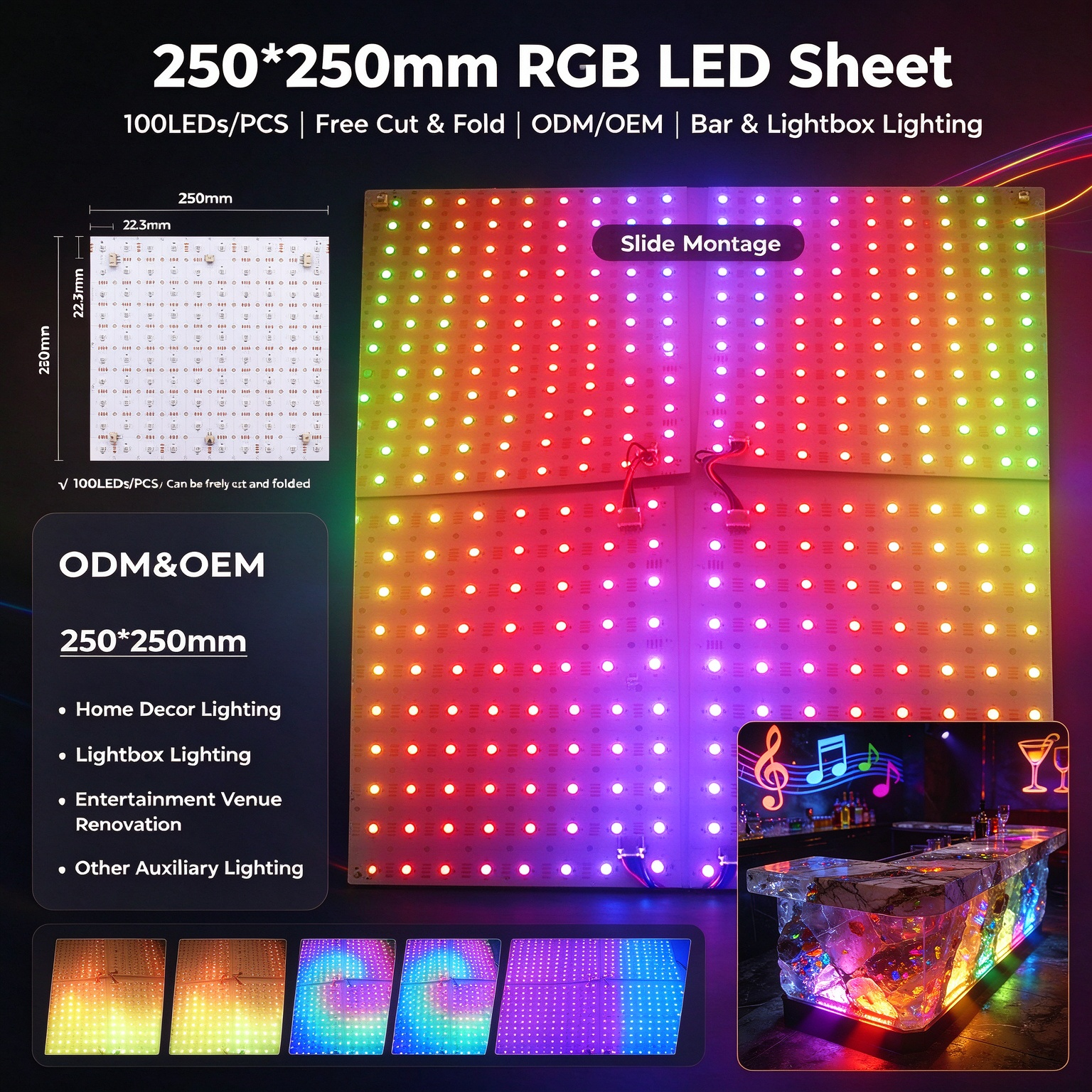
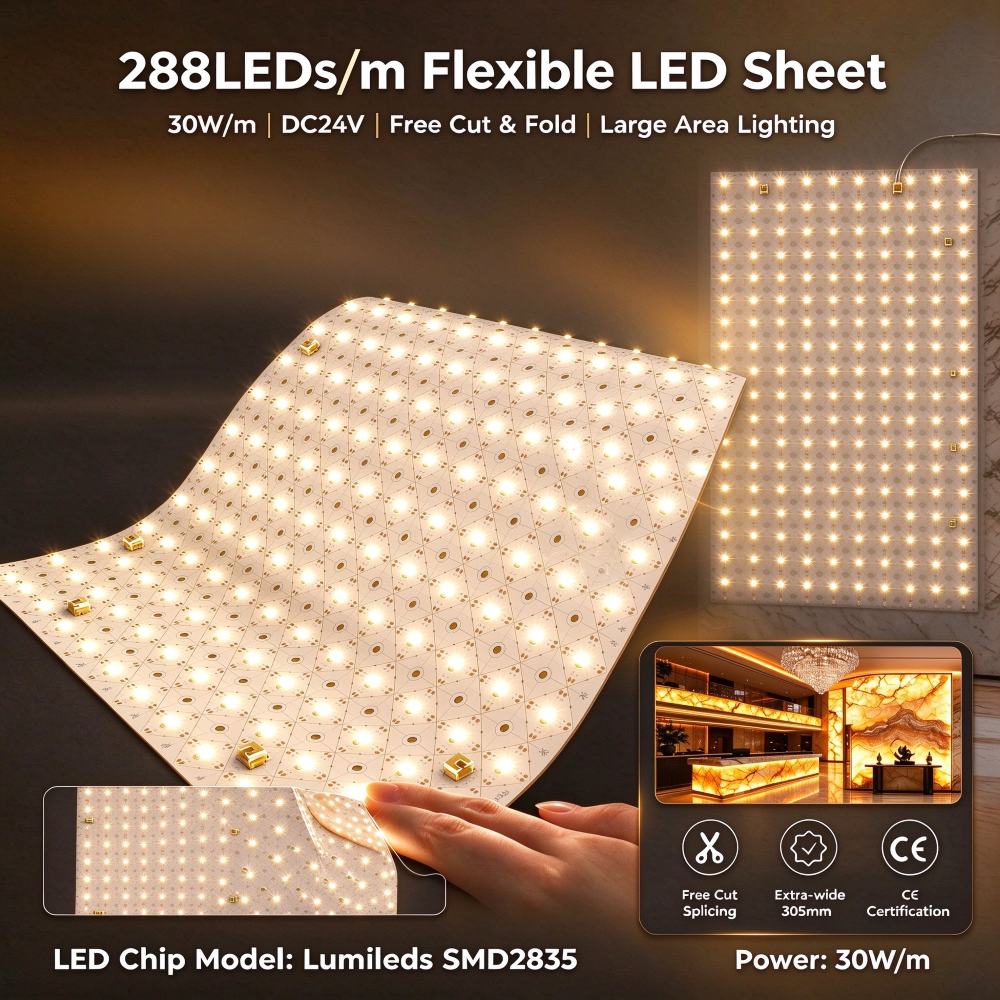
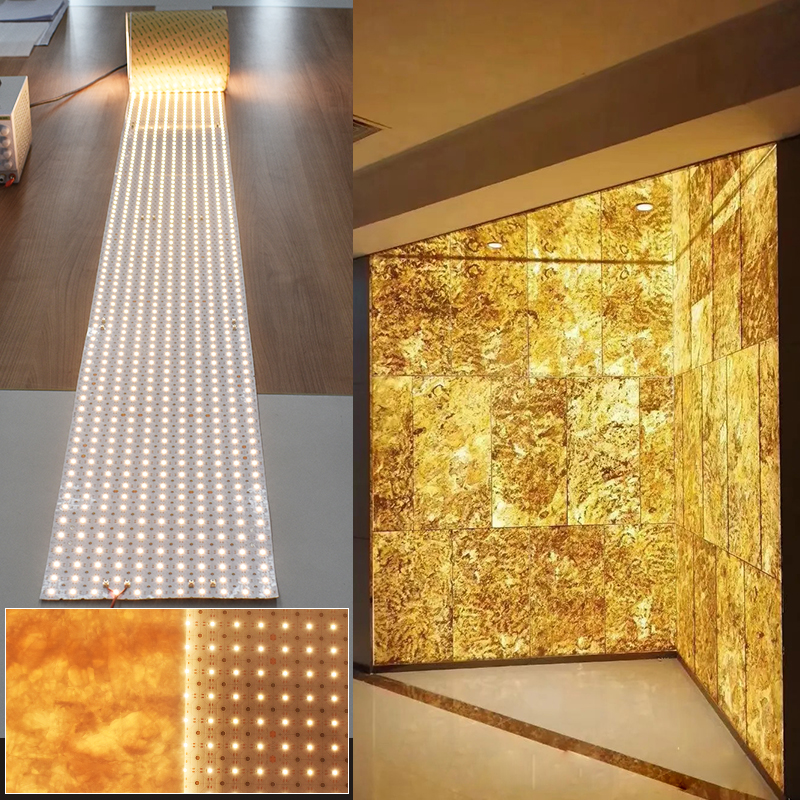
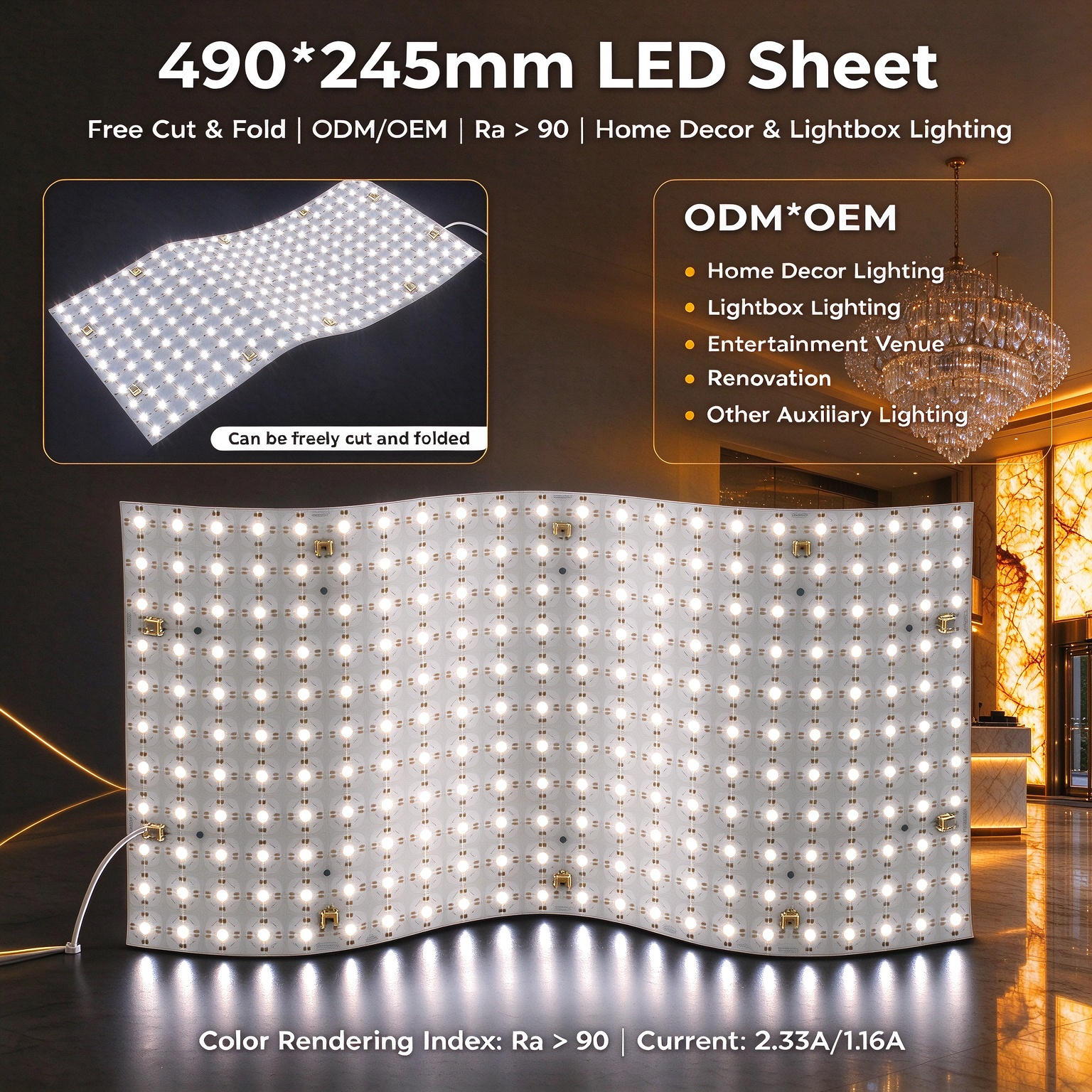
| Cuttable LED Sheet / Matrix Panel | 100 to 1,296 LEDs/m² | Individual 20mm x 20mm grid cuts | Uniform surface brightness with 30mm air gap behind stone | Backlighting translucent marble, onyx, quartz countertops, display walls |
| 360° Silicone CCT Neon Flex | 140 to 280 LEDs/m | 25mm – 50mm | Full 360-degree dotless omnidirectional glow | Pendant decorative rings, organic architectural curves, outdoor structural accents |
3. Global B2B Procurement Trends & Market Dynamics (2025–2030)
The global commercial lighting procurement landscape is undergoing massive transformation driven by legislative updates, smart building automation standards, and wellness certification systems such as the WELL Building Standard™ and LEED v4.1. Enterprise procurement teams, lighting distributors, and OEM specifiers must align their sourcing strategies with five overarching industry trends:
1. Mandatory Adoption of Human-Centric Lighting (HCL)
Scientific research into non-visual photoreceptors (ipRGCs) in the human eye proves that exposure to dynamic light spectra regulates melatonin production, alertness, and sleep quality. Commercial offices, healthcare facilities, and educational institutions now explicitly require CCT-tunable linear lighting. Procuring high-CRI 2200K-6500K CCT strips enables automated lighting systems to simulate natural daylight curves from morning to night.
2. Migration to 48V Extra-Low Voltage Architectures
While 12V and 24V remain popular for short residential runs, large-scale commercial hospitality and airport projects are rapidly adopting 48V Direct Current (DC) LED strip systems. Operating at 48V cuts electrical current in half compared to 24V for identical wattage, allowing continuous single-feed run lengths of up to 20 to 30 meters without voltage drop or visible dimming.
3. Wireless Mesh & DALI-2 / DT8 Protocol Integration
Traditional 0-10V dual-dimmer wiring is being replaced by digital addressable control systems. Modern tunable white systems rely on DALI-2 Device Type 8 (DT8) controllers, which manage both intensity and CCT over a single DALI address. Concurrently, wireless mesh protocols—including Bluetooth Mesh, Zigbee 3.0, and Matter—are being integrated directly into smart driver junction boxes for rapid retrofit commissioning.
4. Rapid Growth of Cuttable Matrix LED Backlight Sheets
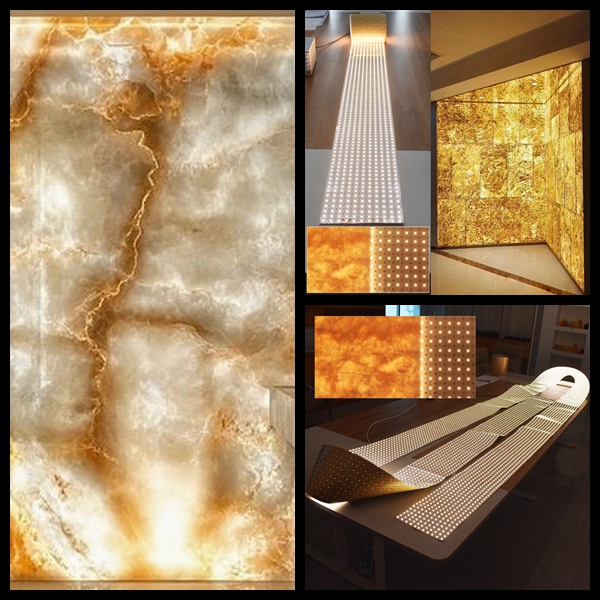
In high-end interior architecture, translucent stone surfaces (alabaster, quartzite, onyx) are becoming standard focal points in hotel lobbies and luxury residences. Conventional edge-lit panels or loose strip runs create hot spots and shadow lines. Flexible, cuttable LED sheets featuring 100 to 1,296 diodes on a modular matrix solve this challenge, offering uniform backlighting that can be trimmed around plumbing, corners, and support columns on site.
4. Future Technological Roadmap: Next-Generation Linear Light Engines
Looking ahead toward the end of the decade, Covek's R&D division is actively investing in three disruptive technologies that will redefine the performance benchmarks for tunable white and dynamic flexible lighting:
A. Micro-CSP (Chip Scale Package) Continuous Arrays: Traditional SMD LEDs rely on plastic leaded chip carriers (PLCC) that degrade under high thermal stress and yellow over time. CSP technology eliminates bonding wires and plastic substrates, placing silicon chips encapsulated in phosphor directly onto the copper FPC. This yields an ultra-thin 1.0mm profile with 180-degree beam angles and superior junction-to-sink thermal resistance.
B. Quantum Dot Phosphor Formulations: To achieve ultra-high CRI (>98) while maximizing luminous efficacy (lumens per watt), traditional narrow-band red phosphors are being replaced with non-toxic Quantum Dot (QD) film coatings. This technology narrows emission bandwidths, minimizing wasted optical energy in invisible infrared spectrums and raising output efficiency by up to 22% compared to standard high-CRI LED packages.
C. Intelligent Integrated Constant Current Drivers (IC-On-Board): By embedding micro-sized linear constant current driver ICs directly at every cutting segment along the FPC, voltage drop across long runs is completely eliminated. Each segment autonomously regulates current flow regardless of supply voltage fluctuations between 22V and 28V, extending system lifespans beyond 50,000 operational hours (L80B10).
5. Frequently Asked Questions (B2B Procurement FAQ)
To assist purchasing directors, engineering consultants, and importers during technical evaluation, our engineering support team has compiled direct responses to common procurement inquiries:
Partner with China's Premier Tunable White LED Factory
Whether you require custom OEM product development, IES files for lighting design, factory-direct wholesale pricing, or immediate sample evaluation, our engineering team is standing by to assist.