Featured CE-Certified Narrow & Flexible LED Series
Engineered for ultra-thin aluminum profiles, marble backlighting, and precision architectural coves with zero hotspotting.

Engineering White Paper: Narrow LED Strip Standards & CE Compliance
An authoritative analysis of micro-PCB thermal mechanics, flip-chip COB encapsulation, and European regulatory compliance for commercial lighting procurement.
1. Architectural Mandates for Ultra-Narrow PCB Form Factors
In modern architectural linear lighting, space constraints within aluminum extrusions, millwork recesses, tile joints, and stone backlighting channels have pushed PCB widths down from traditional 8mm–10mm standards to ultra-narrow form factors of 2mm, 3mm, 4mm, and 5mm. Procuring ultra-narrow LED strips presents unique engineering challenges, specifically regarding current density, thermal dissipation, and structural integrity.
When reducing PCB width to 3mm or 4mm, the cross-sectional area of the copper traces is drastically reduced. Without custom PCB layout optimizations—such as adopting 3oz or 4oz rolled-annealed copper layers—narrow strips suffer from severe electrical resistance. This resistance leads to voltage drop over short run lengths, causing localized overheating and thermal degradation of the LED phosphor encapsulation. Leading OEM factories mitigate this by deploying double-sided 3oz copper flexible printed circuits (FPCs) with micro-vias, guaranteeing continuous luminance uniformity across 5-meter to 10-meter runs.
2. Flip-Chip COB (FCOB) vs. Ultra-Slim SMD Packages
Selecting between Surface Mount Device (SMD) and Flip-Chip Chip-on-Board (FCOB) technology is critical when specifying narrow linear lighting for B2B projects:
SMD Packages (SMD 2016, 1608, 2835): Narrow SMD strips utilize discrete surface-mounted packages placed closely together. While SMD tape can achieve high luminous efficacy (up to 140 lm/W at CRI 90), it exhibits visible pixelation ("hotspots") when installed in shallow aluminum profiles (< 10mm depth) without heavy opal diffusers.
FCOB Technology: FCOB narrow strips mount flip-chip dies directly onto a 3mm or 5mm FPC, encapsulating hundreds of chips per meter under a continuous linear silicone-phosphor matrix. By eliminating gold wire bonding and package lead frames, FCOB strips deliver a seamless, dotless line of light with wider beam angles (180°), lower thermal resistance ($R_{th,j-c}$), and superior mechanical flex tolerance during installation in curved architectural coves.
3. Decoding CE Certification Standards (EN 60598-1, EN 62471, EMC Directive)
For European importers, distributors, and engineering contractors, a generic "CE" mark is legally insufficient without compliant laboratory test reports. Valid CE compliance for narrow LED strips requires rigorous adherence to three core directives:
• LVD (Low Voltage Directive 2014/35/EU & EN 60598-2-21): Evaluates insulation resistance, creepage distances, and mechanical stress resistance on micro-soldered joints across narrow PCBs.
• EMC Directive (2014/30/EU & EN 55015 / EN 61547): Ensures that high-density LED strips and paired PWM dimming drivers do not inject electromagnetic interference into municipal or commercial power lines.
• Photobiological Safety (EN 62471): Verifies that blue light hazard levels fall within Risk Group 0 (Exempt) or RG1, preserving occupant eye safety in high-lux office and residential projects.
• RoHS 3 (Directive 2015/863): Restricts ten hazardous substances, including lead, cadmium, and phthalates, in the solder paste and silicone encapsulant.
Enterprise Capabilities: Shenzhen Covek Lighting Co., Ltd.
A verified OEM/ODM manufacturing engine delivering project-grade flexible LED lighting directly from Shenzhen, China.
TÜV Rheinland Verified Factory
Founded in 2011 in Longhua District, Shenzhen, Covek operates a 5,175 m² facility independently audited and verified on-site by TÜV Rheinland. Full transparency across production lines, trade capacity, and legal compliance.
High-Precision SMT & FCOB Coating
Equipped with high-speed Yamaha and Fuji surface-mount machines capable of mounting micro SMD components onto 2mm–5mm PCBs, alongside automated phosphor dispensing lines for seamless FCOB strip production.
Strict MacAdam 3-Step Binning
To prevent color variance across large commercial installations, Covek enforces 3-step MacAdam Ellipse binning standards. Every batch maintains exact CCT alignment (2700K, 3000K, 4000K, 6000K) across reorders.
OEM & ODM Customization R&D
Our 133-person workforce includes dedicated optical and thermal engineers releasing 20–50 new lighting designs monthly. Custom FPC layouts, buyer branding, custom voltage (12V/24V/48V), and IP68 silicone co-extrusion available.
Comprehensive Certification Package
All products hold full CE, RoHS, EMC, UL, TÜV, ERP, and BIS documentation. Built under ISO 9001 quality management systems, ensuring seamless customs clearance for North American and European importers.
Rapid B2B Sample & Order Execution
Express prototype sampling within 48 hours. Standard OEM production lead time is 7–12 days with 100% aging inspection before shipment. US$1.32M+ verified annual export volume to premier European and US buyers.
Future Procurement & Product Development Trends
Key technical paradigm shifts shaping global LED strip procurement, smart control integration, and architectural specifications over the next decade.
1. Paradigm Shift: Ultra-Narrow FCOB Replacing Traditional SMD Tape
The linear lighting market is experiencing a structural transition from discrete SMD tape (such as 2835 and 5050) toward Flip-Chip COB (FCOB) architectures. Procurement data indicates a 35% year-over-year increase in specification requests for 3mm and 4mm ultra-narrow FCOB strips. The primary driver is the shrinking profile of architectural lighting slots. Designers now require seamless continuous lighting lines in 6mm-wide plaster-in channels and cabinet reveal gaps where traditional diffusers cannot eliminate LED pixelation. FCOB's 180-degree beam dispersion solves this issue natively.
2. Transition to 48V Micro-Current Architectures for Extended Runs
Traditional 12V and 24V linear lighting systems suffer from voltage drop limitations, requiring multiple power feed points every 5 to 10 meters. The industry is rapidly adopting 48V DC architectures for long architectural runs in commercial atrium coves, hotel corridors, and facade lighting. Operating at 48V cuts circuit current ($I$) in half compared to 24V, reducing resistive power loss ($I^2R$) by 75%. This allows continuous single-ended power runs up to 20–30 meters without lumen degradation, lowering electrical installation labor and power supply count for contractors.
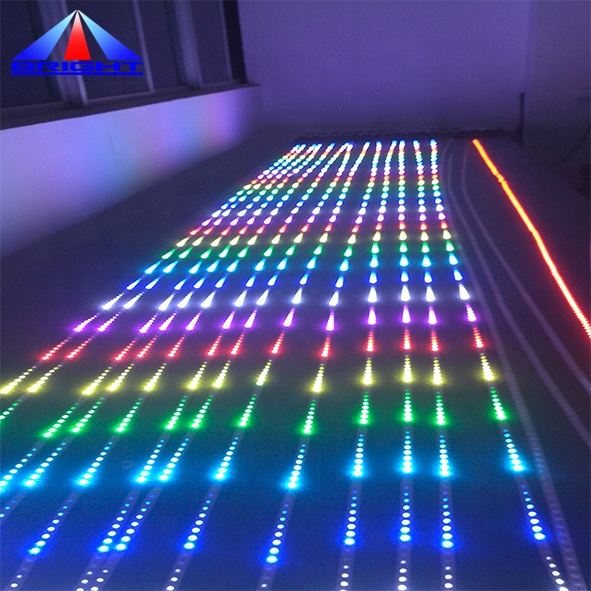
3. Sub-5mm Addressable RGBIC & DMX512 Digital Integration
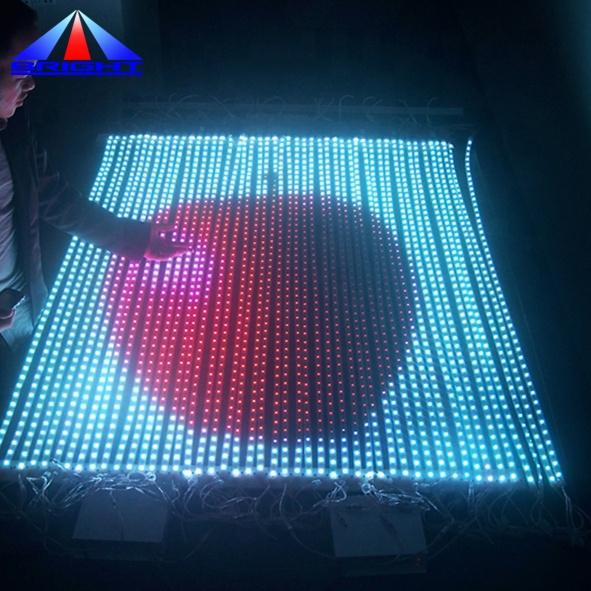
Dynamic lighting control is no longer restricted to wide 10mm or 12mm dynamic tapes. Advances in micro IC encapsulation (such as integrated WS2815, SK6812, and mini-DMX microcontrollers) now enable individual pixel control within 5mm narrow RGB and RGBW form factors. Future procurement trends focus heavily on dual-signal transmission strips (break-point continuous transmission), where an isolated data line ensures that if a single pixel die fails, downstream pixels maintain continuous signal integrity and visual output.
4. Sustainable Silicone Co-Extrusion vs. Traditional PVC Jackets
Environmental regulations across the EU (such as REACH and Ecodesign Directive updates) are accelerating the phase-out of PVC-encapsulated neon flex and IP67 strips. High-grade food-grade silicone co-extrusion has become the benchmark. Silicone offers superior UV resistance (yellowing index $< 1.5$ over 5 years), wider temperature tolerance ($-40^\circ\text{C}$ to $+80^\circ\text{C}$), enhanced flame retardancy, and complete recyclability, meeting green building standards such as LEED and BREEAM.
Specification Matrix: Narrow Linear Lighting Form Factors
A comparative technical reference for lighting designers, procurement managers, and OEM buyers.
| Specification Parameter | 3mm / 4mm Ultra-Narrow FCOB | 5mm High-Density SMD Tape | Cuttable LED Sheet Panel | Slim Neon Flex (4mm/6mm) |
|---|---|---|---|---|
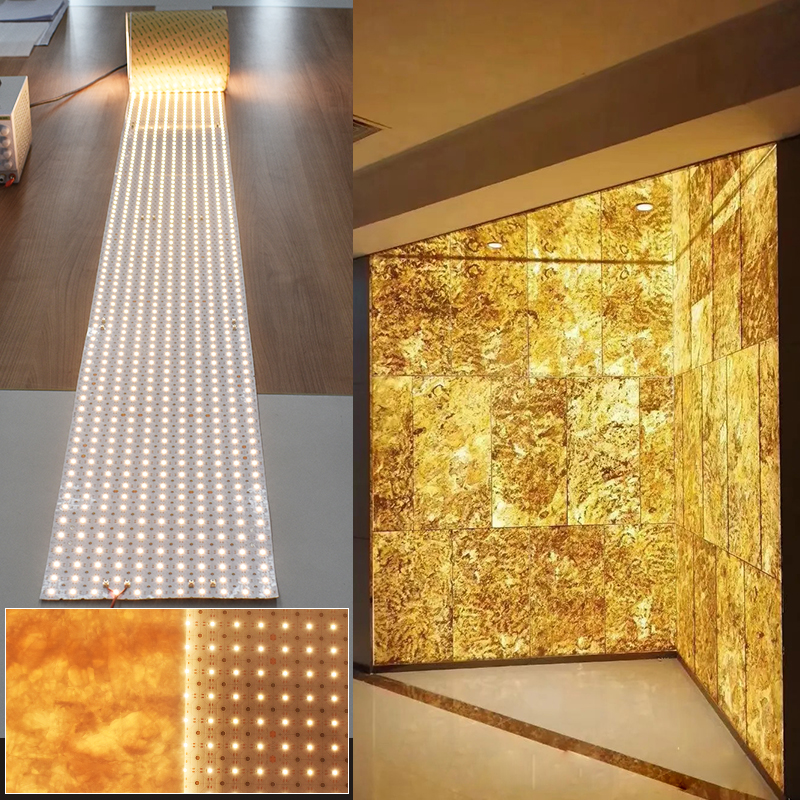
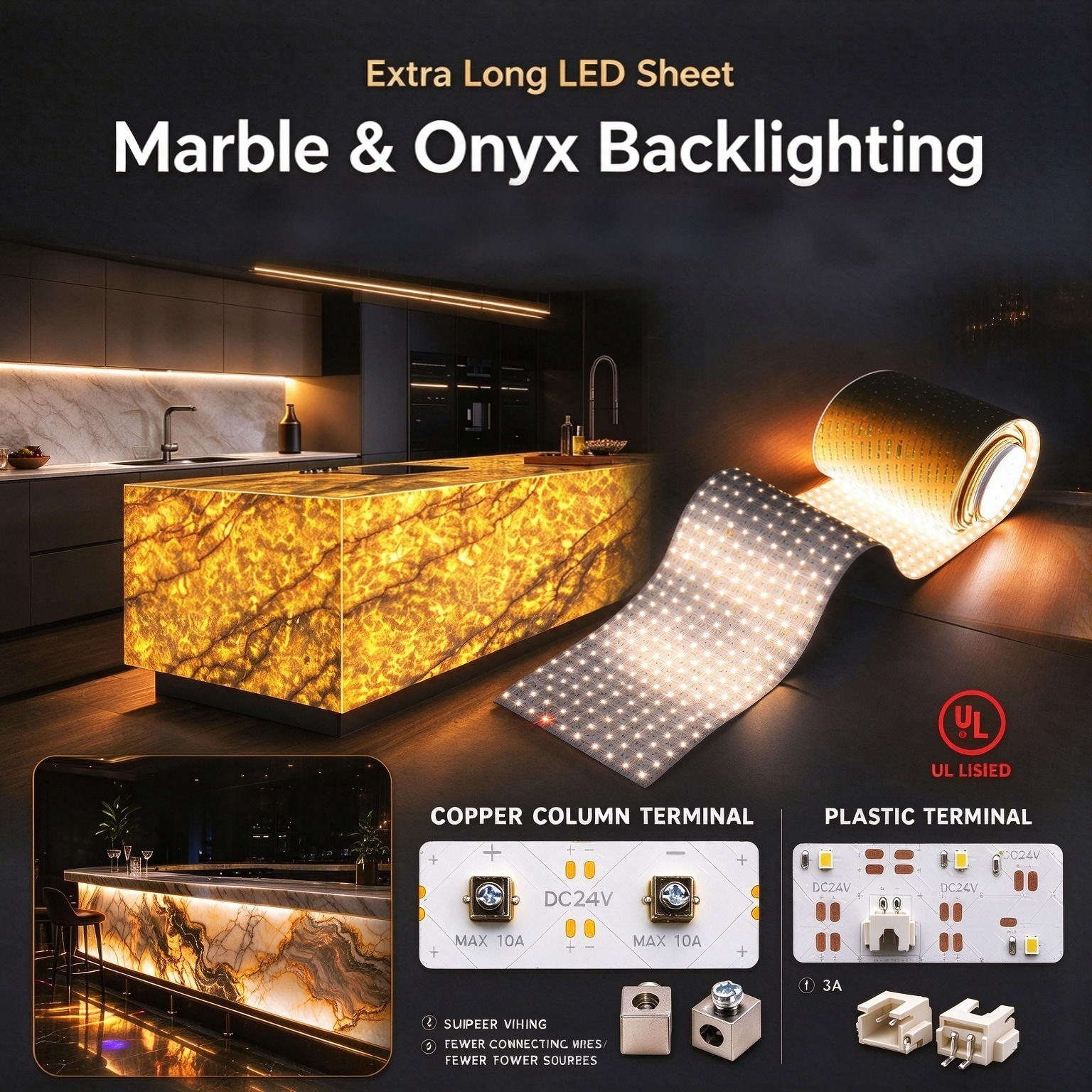
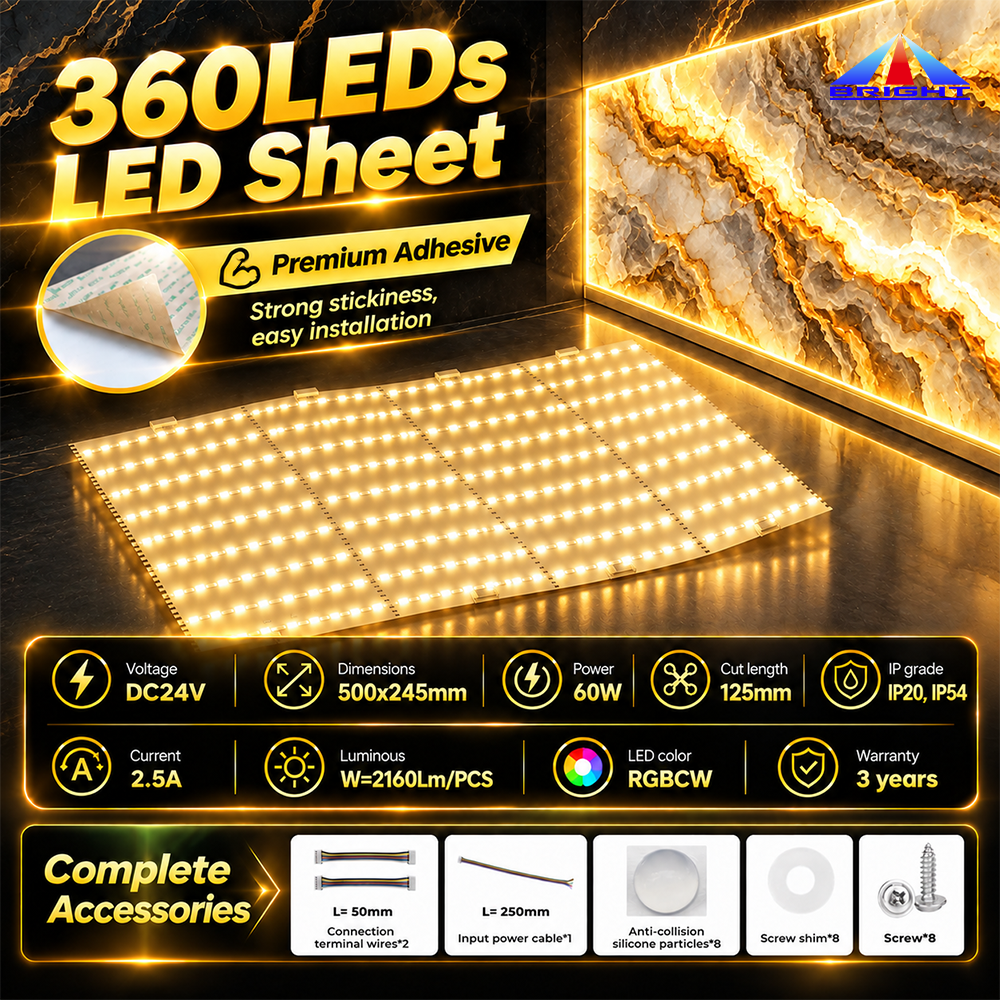
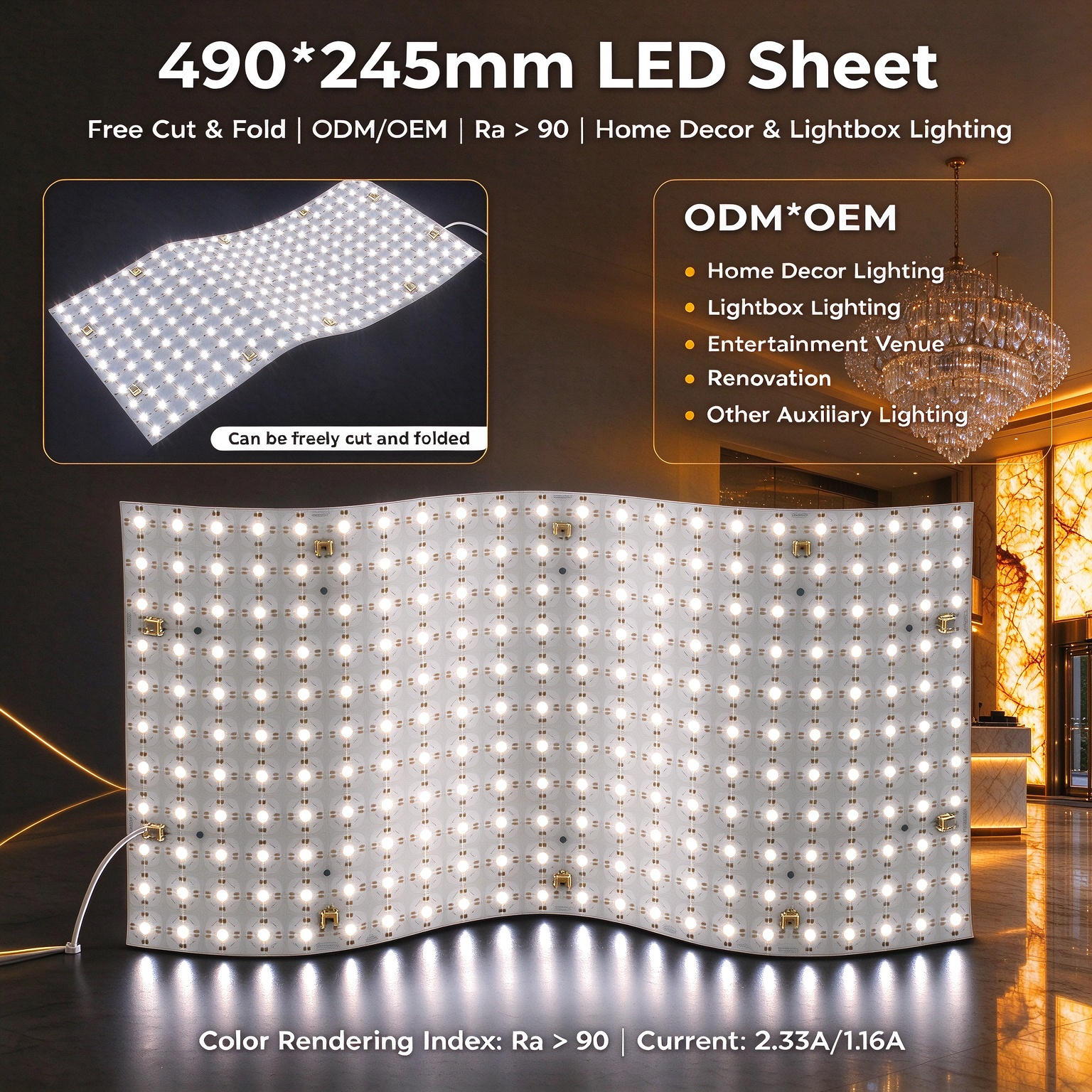
| Primary Application | Ultra-thin profiles, hidden coves, millwork joints | Cabinet backlighting, narrow channels | Marble, onyx, translucent stone backlighting | Commercial signage, building facade outlines |
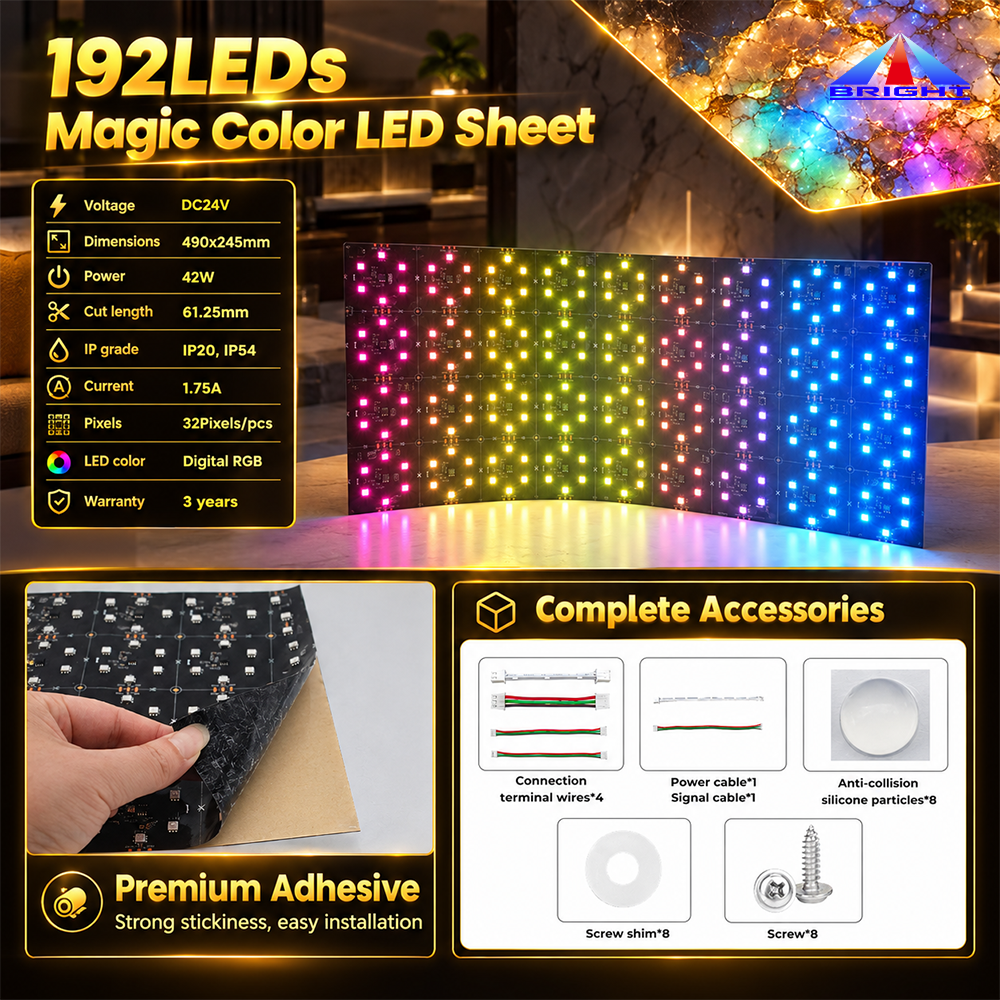
| LED Density | 480 – 840 chips/meter | 120 – 240 LEDs/meter | 242 – 1,296 LEDs/sheet | 120 – 180 LEDs/meter |
| Luminous Efficacy | 90 – 110 lm/W | 110 – 140 lm/W | 100 – 120 lm/W | 70 – 90 lm/W (silicone loss) |
| Color Rendering Index | CRI 90 / CRI 95 (R9 > 80) | CRI 80 / CRI 90 | CRI 90 / CRI 95 | CRI 80 / CRI 90 |
| Operating Voltage | DC 12V / 24V | DC 12V / 24V / 48V | DC 24V | DC 12V / 24V |
| Dotless Performance | 100% Continuous (No diffuser needed) | Requires >15mm profile depth + diffuser | Requires >30mm stone distance | 100% Uniform diffuse glow |
| Flexibility & Cutting | Cuttable every 10mm–25mm | Cuttable every 25mm–50mm | Grid-cuttable in 2D directions | Cuttable every 10mm–50mm |
| CE Compliance Standard | EN 60598-2-21, EN 62471, RoHS 3 | EN 60598-2-21, EN 55015 | EN 60598-1, EMC Directive | EN 60598-2-21, IP67 / IP68 EN 60529 |
Global Sourcing & Technical FAQ
Expert answers to common engineering, quality control, and international trade questions regarding CE certified narrow LED strips.
Why is thermal management critical for narrow (2mm–5mm) LED strips, and how is it solved?
What specific CE documentation should an importer request before placing a bulk order?
What is the difference between single-ended and double-ended power feeding in narrow strips?
Can ultra-narrow LED strips be customized for OEM/ODM brand specifications?
How does cuttable LED sheet backlighting compare to edge-lit panel solutions for stone installations?
What IP ratings are recommended for indoor vs. outdoor narrow linear installations?
What is WS2815 addressable technology and why is it preferred over WS2812B in B2B projects?
What are standard lead times, MOQs, and shipping terms for wholesale orders?
Partner with a TÜV-Verified LED Strip Manufacturer
Looking for reliable CE-certified narrow LED strips, FCOB tapes, or cuttable marble backlighting sheets for your wholesale distribution or commercial project? Contact our engineering sales team today for factory-direct pricing, IES files, and free OEM sample kits.