
1. The Evolution of Architectural Lighting: Why RGBIC is Replacing Traditional RGB
The global commercial and high-end residential lighting market is undergoing a fundamental structural transition. Traditional 4-pin RGB (Red-Green-Blue) strip lights, which manipulate all diodes along an entire circuit line simultaneously, are no longer sufficient to meet modern architectural design benchmarks. Today's lighting engineers, hospitality designers, and system integrators overwhelmingly demand RGBIC (Red-Green-Blue Integrated Circuit) technology.
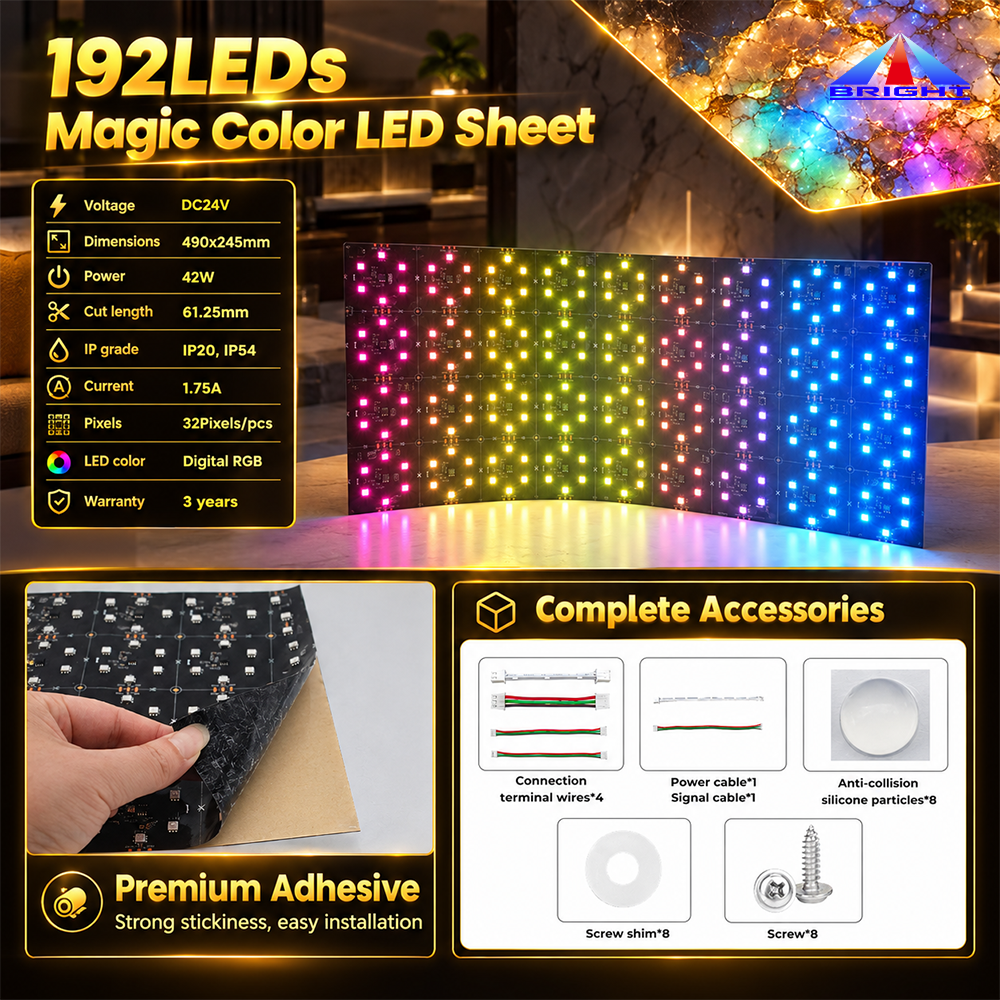
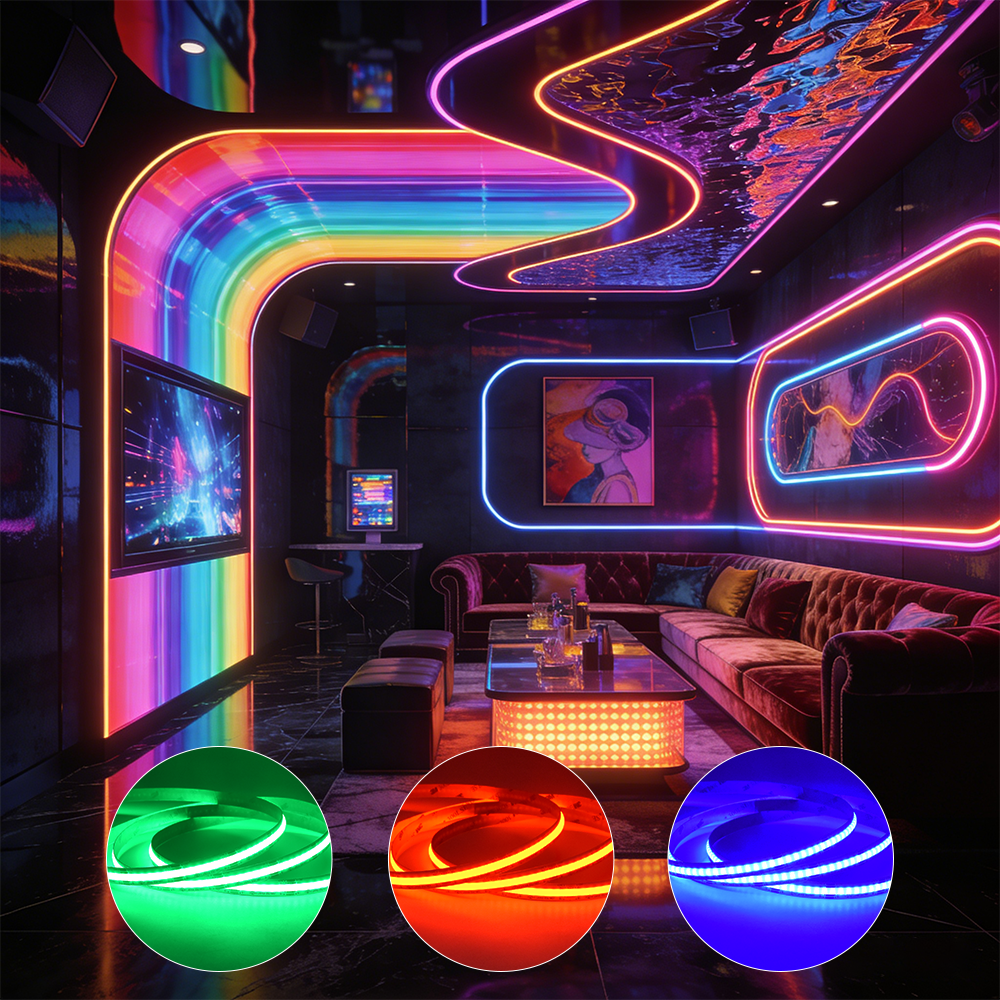
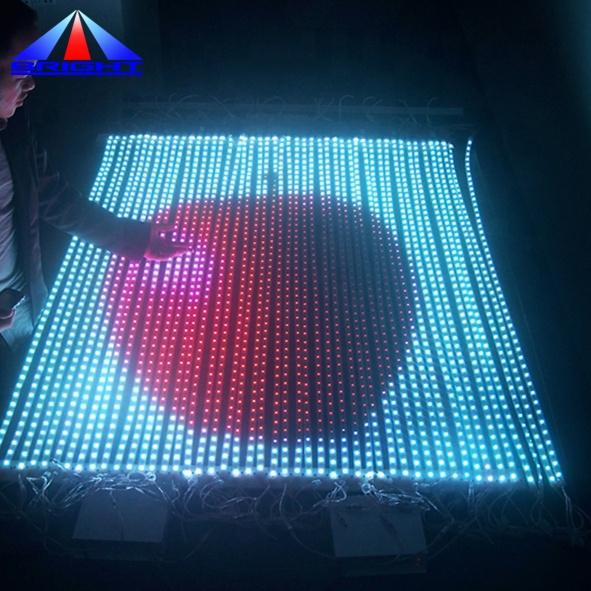
Unlike standard analog RGB strips, RGBIC lighting tapes integrate micro-control IC chipsets directly within each LED package or pixel node along the Flexible Printed Circuit (FPC). This architecture enables individual pixel addressability, allowing multi-color chasing, localized dynamic dimming, complex spatial light shows, and seamless white-spectrum blending on a single linear strip.
Key Differences: Standard RGB vs. RGBIC Addressable Architecture
From an electrical and photometric standpoint, RGBIC technology solves the critical limitation of color homogeneity. In standard RGB strips, cutting or controlling a section alters the voltage across the entire line, leading to uneven luminescent degradation. RGBIC utilizes dedicated internal data lines (SPI or DMX512 protocols) that process high-speed PWM (Pulse Width Modulation) commands independently per node.
| Performance Metric | Standard Analog RGB Strip | Addressable RGBIC Tape | FCOB / COB RGBIC Strip |
|---|---|---|---|
| Color Control | Single uniform color across entire run | Multi-color pixel control per segment | Seamless dotless multi-color chasing line |
| IC Chip Integration | None (External PWM Dimmer) | External or Internal IC (WS2815, UCS1903) | Micro-Flip-Chip integrated under phosphor |
| Visual Hotspots | Visible LED dots (Requires deep profile) | Visible LED dots (Requires diffuser) | 100% Dotless Continuous Line |
| Break-Point Continuity | N/A (Analog parallel wire) | Single dead chip stops signal (Standard IC) | Dual-Data Break-Resume (WS2815/WS2813) |
| Voltage Drop Resistance | High (Requires frequent power injections) | Moderate (12V / 24V dependent) | Superior (24V / 48V Constant Current) |
2. IC Protocols & Semiconductor Engineering Breakdown
As a leading Chinese manufacturer and OEM partner, Shenzhen Covek Lighting Co., Ltd. categorizes addressable RGBIC strip solutions into three primary signal classes, ensuring complete compatibility with global control systems such as Art-Net, DMX512, Arduino, Raspberry Pi, and Tuya/Matter IoT ecosystems:
- Single-Signal ICs (UCS1903 / SM16703): Cost-effective protocol widely used in decorative residential tape and commercial retail signage where basic pixel chasing is sufficient.
- Dual-Signal Break-Point Resume ICs (WS2815 / WS2813): Engineered specifically for high-reliability commercial projects. Featuring dual-data lines (Data + Backup Data), if a single LED pixel suffers mechanical or thermal damage, the signal automatically bypasses the defective node, allowing remaining LEDs to maintain 100% operational synchronicity.
- Differential DMX512 ICs (UCS512 / TM512): Designed for architectural facades, stage lighting, and large-scale structural illumination. Communicates directly with industry-standard DMX consoles without signal conversion boxes, supporting transmission distances up to 100 meters between nodes.
3. Soling the Physics of Voltage Drop: 12V vs. 24V vs. 48V Long-Run Architectures
One of the most persistent technical challenges in B2B lighting installation is voltage drop over long linear distances. When direct current (DC) flows through a thin copper FPC track, inherent resistance causes electrical energy to convert into thermal dissipation. The result is a visible shift in color accuracy and brightness toward the tail end of the strip.
To eliminate this bottleneck for electrical contractors, Covek Lighting has pioneered high-voltage, low-current circuit designs:
- 12V DC Systems: Suitable for localized furniture backlighting, automotive retrofits, and short runs under 5 meters.
- 24V DC Systems: The architectural industry standard. By doubling voltage, current draw is reduced by 50% for equivalent wattage, halving heat generation and allowing single-ended power runs up to 10 meters without visible luminance drop.
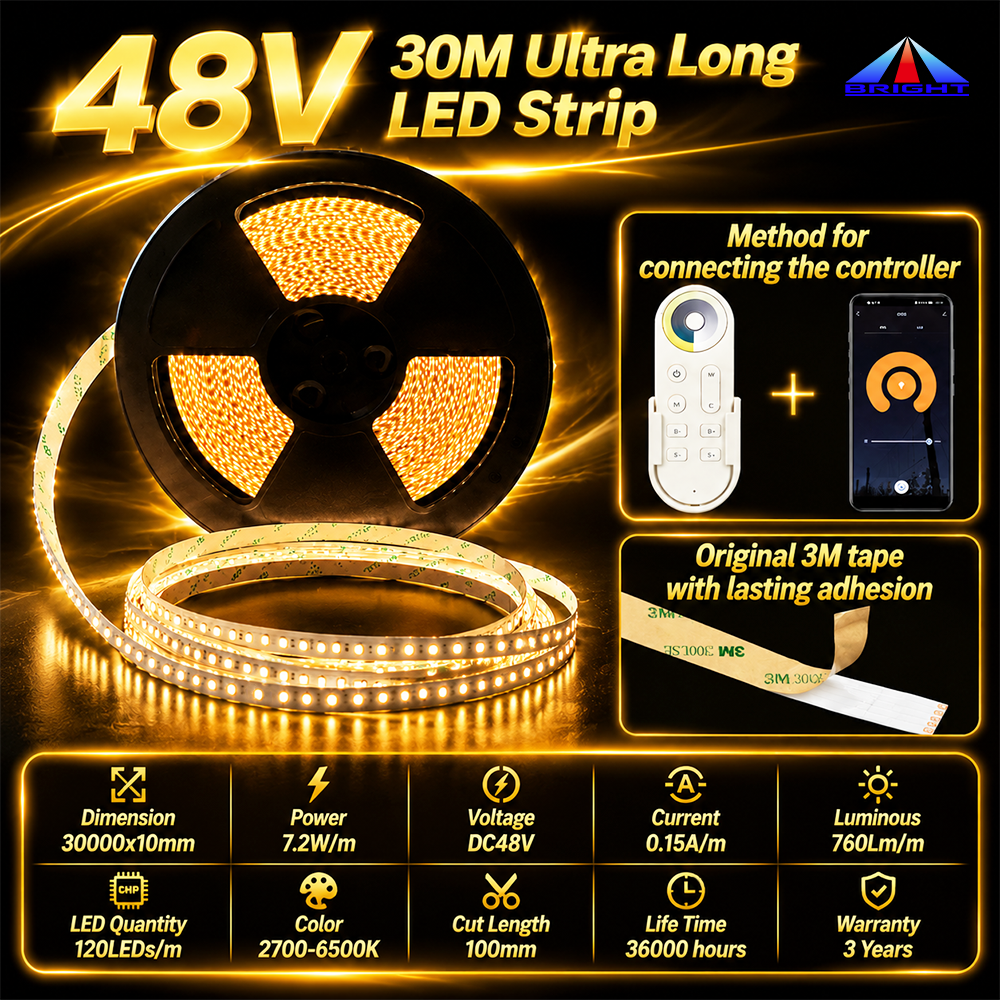
- 48V DC Ultra-Long Systems: Engineered specifically for hotel corridors, perimeter perimeter coves, and high-bay commercial installations. Operating at 48V DC permits continuous single-feed runs of 20 to 30 meters with less than 3% photometric decay, drastically reducing power supply driver count and installation wiring costs.
4. FCOB (Flip-Chip on Board) RGBIC: The Ultimate Dotless Illumination
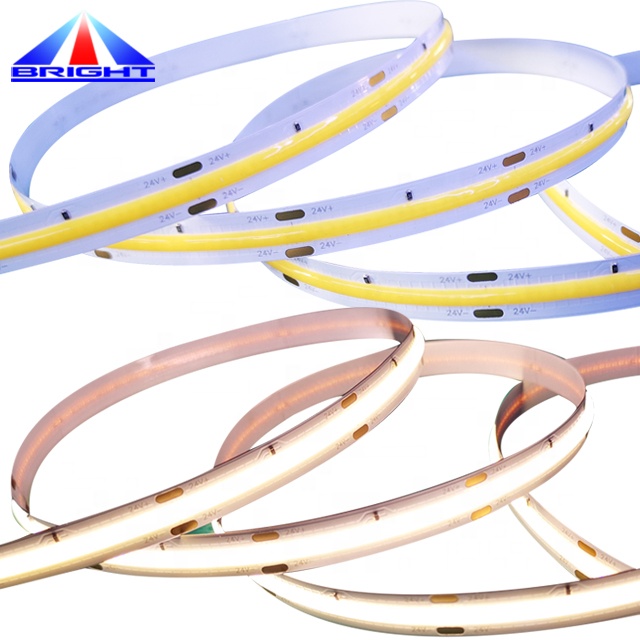
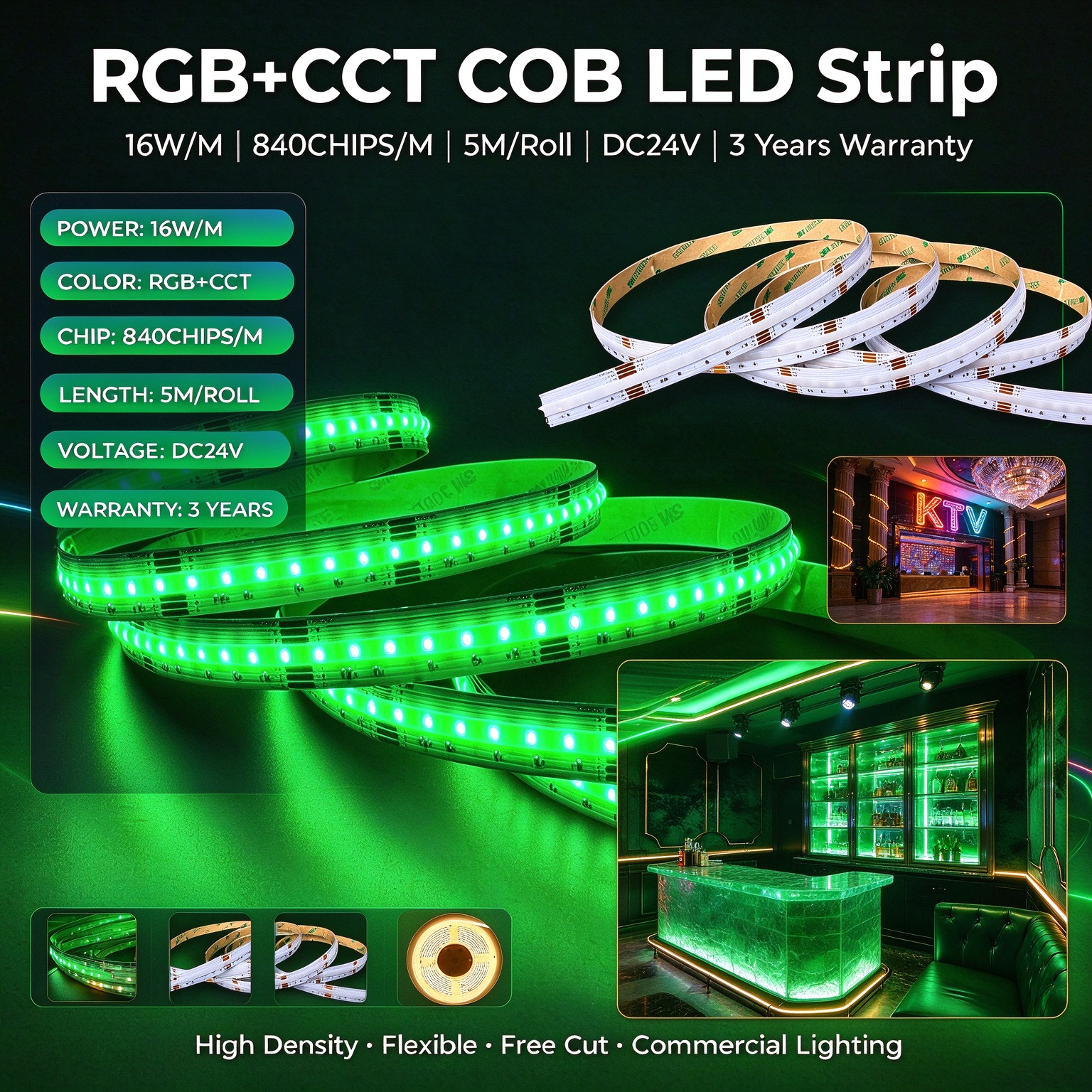
While traditional SMD (Surface Mounted Device) LEDs rely on discrete plastic packages soldered onto an FPC board, FCOB RGBIC technology directly mounts un-packaged silicon flip-chips directly onto the FPC copper track, encasing them beneath a continuous flexible silicone phosphor matrix. With chip packaging density exceeding 672 to 840 chips per meter, FCOB strips completely eliminate visual spot gaps, providing smooth, neon-like illumination even inside shallow aluminum profiles with clear lenses.