TÜV Rheinland Verified Manufacturer Exporting to North America & Europe [email protected]
EN
0%

LED Strip Lights can transform a dark shelf, display case, or kitchen edge with a clean line of light. Yet a bright product photo reveals little about its performance. Buyers must compare output per metre, colour consistency, heat management, and driver compatibility—not just wattage or price. Small details matter.

The U.S. Department of Energy’s 2019 Energy Savings Forecast of Solid-State Lighting projected that LED lighting could save about 569 terawatt-hours annually by 2035 against its modeled baseline. This estimate covers general illumination, not strip lights alone. It still shows why efficiency claims deserve careful checking. For strips, ask for measured lumens per metre, efficacy, colour-rendering data, and test conditions. A high lumen figure can disappoint when a diffuser softens the beam or a long run suffers voltage drop.

Dr. James Brodrick, who led the U.S. DOE’s Solid-State Lighting program, has emphasized evaluating lighting as a complete system rather than judging the LED component alone. That principle matters here: tape, power supply, controls, profile, and installation all affect the result. Not every supplier provides equally detailed evidence. That is worth noticing. This guide’s ten buying tips will help global buyers examine specifications, colour temperature, CRI, voltage, dimming, IP rating, adhesive, thermal design, certification documents, and supplier support. Requirements and test methods vary by market, so confirm local needs before ordering. Even then, a sample run is wiser than trusting a polished catalogue.
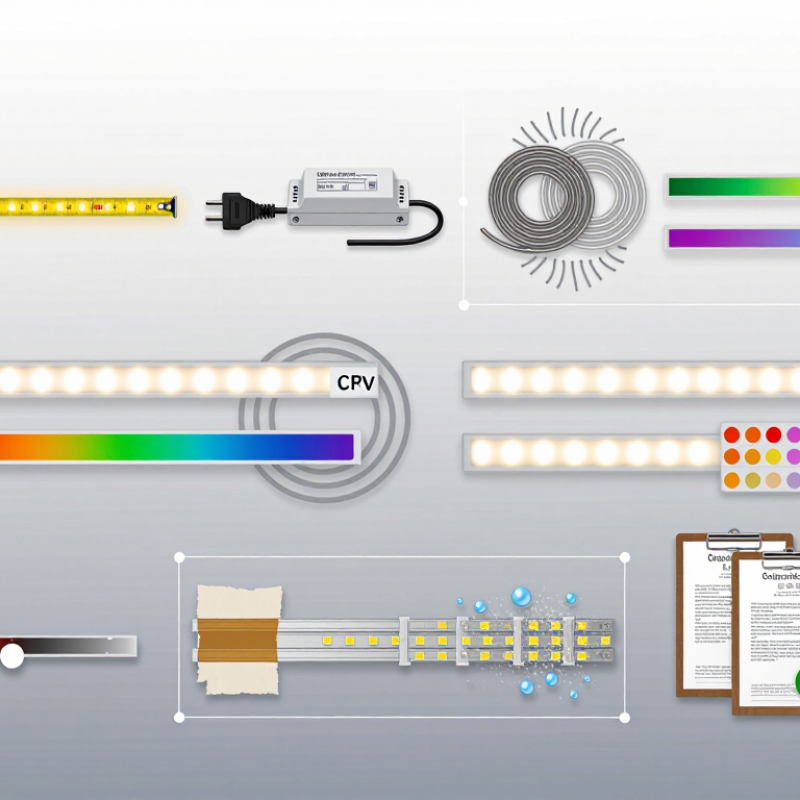
10 LED Strip Lights Buying Tips for Global Buyers

Understanding LED Strip Types and Their Intended Applications

LED strip lights differ in chip layout, color output, brightness, and flexibility. Single-color strips suit task lighting under kitchen cabinets or inside display shelves. Tunable-white strips adjust from warm evening light to cooler work light, but they need a compatible controller. RGB strips create changing colors for decorative accents. RGBW versions add a separate white channel, often producing more useful white light.

The intended location matters as much as the light effect. A dense, dot-free COB strip can look smoother along a visible shelf edge, while standard SMD strips may work well in concealed coves. For bathrooms or outdoor edges, check the stated ingress protection rating and whether connectors and cut ends retain that protection. A rating alone does not make every installation weatherproof. That detail matters.

Match voltage, power demand, and controller capacity before ordering. Long runs can show uneven brightness if voltage drop is ignored; feed them from suitable points and follow the supplier’s wiring guidance. Check the cut marks. Also measure the channel or mounting surface, since a strip that fits the space may still run too hot without proper heat dissipation. Specifications can look reassuring, yet real results depend on installation, so test a short sample in the intended setting when possible.

LED Strip Types by Ingress Protection and Intended Application

IP20 strips are intended for dry indoor locations. IP65 strips are dust-tight and protected against water jets, making them suitable for many exposed areas when properly installed. IP67 strips are dust-tight and protected against temporary immersion under specified test conditions. In an IP rating, the second digit describes water protection; the ratings are test categories, not a linear performance scale. Always check the product’s installation requirements, including how cut ends are sealed.

Matching Voltage, Brightness, Color, and Control Requirements

Start with the installation’s power supply, not the product photo. Check whether the strip requires 12 V or 24 V DC, then confirm the driver accepts the local mains input and provides the correct output. A mismatch can cause flickering, dimming, or early failure. Measure the full run: long strips may lose brightness toward the far end. A suitable 24 V system or additional power feed can help. Keep the driver and connectors accessible. Small detail, big difference. Also check the strip’s cutting intervals before ordering; they may not match every cabinet or shelf length.

Compare brightness in lumens per meter, rather than relying on wattage alone. For kitchens or work areas, stronger output and a color rendering index around 90 can make surfaces appear more natural. Warm white feels softer; cool white can look sharper. RGB strips offer color effects, while RGBW models add a separate white LED for more useful everyday lighting. Specifications do not always show how colors look in a real room, so a sample can be worthwhile. Finally, match the controller to the strip: confirm dimming support, control method, and whether it handles single-color, tunable-white, or RGB output. A control system that seems convenient on paper may feel fussy in daily use.

10 LED Strip Lights Buying Tips for Global Buyers - Matching Voltage, Brightness, Color, and Control Requirements
No. Buying Tip What to Check Practical Guidance
1 Match the Supply Voltage Confirm the strip’s rated voltage and the available power supply output. Common constant-voltage strips operate at 5 V, 12 V, or 24 V DC. The strip and power supply must use the same voltage. For equal power, a 24 V strip draws less current than a 12 V strip, which can help reduce voltage drop on longer runs.
2 Choose Suitable Brightness Compare measured light output, typically stated in lumens per metre, and consider the intended use. Lower-output strips may suit accent lighting, while brighter models are more appropriate for task or primary lighting. Output varies considerably by strip design, so compare the same measurement basis and check whether the figure applies to the full strip or a specific length.
3 Select the Right White Color Check the correlated color temperature (CCT), measured in kelvins (K). About 2700–3000 K generally appears warm, 3500–4000 K neutral, and 5000–6500 K cool or daylight-like. For a consistent installation, use strips with a matching CCT and, where available, a stated color-tolerance specification.
4 Check Color Rendering Look for the color rendering index (CRI), especially for retail, display, and work areas. CRI 80 or higher is a common baseline for general lighting; CRI 90 or higher can help colors appear more naturally. Compare the stated rating and test method, since CRI alone does not describe every aspect of color quality.
5 Choose the Color Format Decide between single-color white, tunable white, RGB, RGBW, or individually addressable strips. Tunable-white strips adjust between warm and cool white. RGB mixes red, green, and blue for colored effects; RGBW adds a separate white channel. Addressable strips allow individual sections or pixels to display different effects but require a compatible controller and data protocol.
6 Match the Control System Confirm dimmer, controller, and strip compatibility, including channel count and control method. Check whether the product uses PWM dimming, an addressable data signal, or another specified interface. RGB, RGBW, tunable-white, and addressable products do not all use the same controller. Verify compatibility with the intended wall control, remote, or smart-home system.
7 Select an Appropriate IP Rating Consider exposure to dust, splashes, cleaning, or outdoor weather. IP20 products are generally intended for dry indoor locations. Higher ratings can provide greater protection, but the rating and installation details matter: connectors, cut ends, and power supplies may need separate protection. Check the product documentation and local electrical requirements for the actual environment.
8 Size the Power Supply Correctly Use the strip’s rated watts per metre and the planned installed length. Calculate total load as watts per metre × metres installed. Select a power supply with the correct DC voltage and adequate rated output; allowing roughly 20–30% capacity above the calculated load is a common planning margin. Follow the manufacturer’s limits for maximum continuous run length.
9 Plan for Voltage Drop Consider run length, strip voltage, conductor size, and the manufacturer’s maximum-feed guidance. Voltage drop can make the far end of a long strip dimmer or change its color. Use the recommended maximum run length, suitable wire, and feed points; some installations need power injected at more than one point. Do not exceed the strip or connector current ratings.
10 Check Cutting and Installation Details Verify cut marks, segment length, strip width, mounting surface, and connector dimensions before ordering. Cut only at the marked points, which vary by product. Measure the channel or mounting area and confirm that the strip, connectors, and bend radius fit. Clean, dry, heat-dissipating surfaces and appropriate mounting accessories can improve adhesion and service life.

Evaluating Materials, Lifespan, and Environmental Protection

LED strip quality begins with the materials hidden beneath the glow. Check the copper circuit board, adhesive, and outer coating, not just the stated wattage. Thin copper traces can heat up under sustained use, especially in tightly packed channels. A silicone sleeve may resist moisture better than a basic coating, but it can still yellow under strong sunlight. Small details matter.

The U.S. Department of Energy reports that LED lighting uses at least 75% less energy and can last up to 25 times longer than incandescent lighting. That comparison is useful, but it does not guarantee a strip’s service life. Ask for rated-life evidence and test information, such as LM-80 data for LED packages and TM-21 projections. Also check operating temperature: a strip mounted against aluminum may shed heat better than one stuck to painted wood. I have seen buyers trust the headline hours too quickly. The power supply and connectors can fail first.

Environmental ratings need careful reading. IEC 60529 defines IP protection classifications, but an IP rating does not prove resistance to prolonged UV exposure or corrosive air. An IP67 strip, for example, still depends on sealed joints and compatible connectors. Ask whether the rating covers the complete assembly, not only the coating. A weak joint can undo good protection.

Checking Safety Certifications and Regional Compatibility

Global buyers should verify the complete lighting system, not just the LED strip. Check the strip, power supply, controller, and plug for approval in the destination market. North American buyers may look for recognized certification such as UL or ETL; other regions use different conformity routes. A CE mark is a manufacturer’s declaration, not automatically proof of independent testing. Read the documentation carefully. Small print matters.

Match the power supply to local mains voltage and frequency, then confirm the strip’s required output voltage. A 12-volt strip needs a compatible 12-volt supply; the wrong unit can cause overheating or failure. Also check dimmer compatibility and the IP rating for the actual installation location. An IP rating describes protection against dust and water, not electrical certification. The U.S. Department of Energy reports that LED lighting uses at least 75% less energy than incandescent lighting. That broad comparison is useful, but it does not replace checking a strip’s own specifications.

Tips: Request the certificate or declaration for the exact model, including its power supply. Compare model numbers against the paperwork. Confirm local plug type, voltage, and frequency before ordering. Keep installation instructions with the product. One detail is easy to miss: a certified adapter does not necessarily certify every connected component. I would still verify the full set with the supplier, especially when regional paperwork is unclear.

Comparing Suppliers, Warranty Terms, and Total Costs

A low unit price can hide costly gaps. Compare suppliers using the same specification: voltage, watts per meter, color temperature, LED density, cut length, and ingress protection. Ask for a recent test report and a sample from the production batch, not only a polished catalog image. Check whether color variation between batches is measured and controlled. It matters when strips meet across a long ceiling.

Read warranty terms line by line. Confirm coverage length, required installation conditions, proof of failure, and who pays return freight or replacement shipping. Ask whether labor, connectors, power supplies, and color shift are covered. A five-year warranty may offer less protection than a shorter one with clear remedies. Small print matters.

Compare total landed cost, not just the quoted strip price. Include drivers, profiles, connectors, customs charges, freight, spare stock, and installation time. The U.S. Department of Energy’s 2019 Energy Savings Forecast projected that solid-state lighting could reduce U.S. lighting energy use by 75% by 2035. That is a broad market forecast, not a guarantee for one LED strip. The DOE’s Energy Saver guidance also notes that LED bulbs can last up to 25 times longer than incandescent bulbs; strip performance depends on thermal design and operating conditions. That comparison is imperfect. A warm aluminum profile, for example, can affect service life. Ask suppliers how they test strips after aging, and request the test conditions in writing. A missed detail can erase the apparent savings.

FAQS

How do I choose the correct voltage for an LED strip?

Check whether the strip needs 12 V or 24 V DC. Match it with a compatible power supply. A mismatch may cause flickering, dimming, or early failure.

Why can a long LED strip look dimmer at one end?

Voltage can drop along a long run. Measure the full length and consider a 24 V system or an additional power feed. Keep connectors accessible.

How should I compare strip brightness and color quality?

Compare lumens per meter, not wattage alone. A color rendering index near 90 can help work surfaces look natural. A sample may help. Room lighting changes the impression.

What is the difference between RGB and RGBW strips?

RGB strips create colored effects. RGBW models add a separate white LED, which can be more useful for everyday lighting. Check controller compatibility before buying.

Which materials and construction details should I inspect?

Check the copper circuit board, adhesive, and outer coating. Thin copper traces may heat up during sustained use. Small detail, big difference.

Does an advertised lifespan guarantee how long a strip will last?

No. Ask for rated-life evidence and relevant test information. Heat, connectors, and the power supply can affect service life. I would not trust headline hours alone.

What does an IP rating tell me about a strip?

It describes protection against dust and water, but not necessarily sunlight or corrosive air. Check whether the rating covers the complete assembly. A weak joint can undo it.

What should I verify before ordering for another region?

Check local mains voltage, frequency, plug type, and required output voltage. Request documents for the exact strip, supply, and controller models. Read the paperwork. A certified adapter does not automatically certify every connected part.

Conclusion

Choosing LED Strip Lights for global projects requires matching the product to its intended use, whether for decorative accents, task lighting, or outdoor installation. Compare strip types and check that voltage, brightness, color temperature, color options, and control methods suit the space and power setup. Consider the strip’s materials, expected lifespan, heat management, and level of protection against moisture or dust, especially when it will be used in demanding environments.

Before purchasing, confirm that safety certifications and electrical specifications are appropriate for the destination market. Evaluate suppliers by reviewing product consistency, communication, warranty coverage, and after-sales support. Compare the full cost rather than the unit price alone, including power supplies, controllers, shipping, installation, and potential replacement needs. A careful assessment of these factors can help buyers select reliable lighting that fits both project requirements and budget expectations.

Ethan

Ethan

Ethan is a professional marketing specialist who brings a deep understanding of the company’s products and the needs of the people who use them. Through ongoing research and close collaboration with colleagues across the business, he keeps his knowledge current and turns detailed product......